top of page

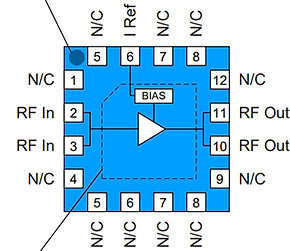
For the low-level signal driver amplifier, a cascaded amplifier configuration from the manufacturer Qorvo was chosen, with a gain of 15 dB and a 1 dB compression point of approximately 27 dBm (0.5 watts). For the second, power stage, a GaN HEMT amplifier from the manufacturer Macom was used, with a gain of 17 dB and a maximum output power of Psat = 39 dBm (8.5 W).

Based on the reference circuit, linearized models of scattering parameters, and the component layout on the PCB, circuit simulations were performed, which confirmed the achievement of the required parameters for the application. Subsequently, the PCB layout was created, the boards were manufactured, assembled, and experimentally verified. To achieve the desired parameters and adjust the amplifier, the selected components and their values were fine-tuned.


Using a vector network analyzer, the scattering parameters of the circuits were measured at the operating points. Subsequently, the achieved power levels of the individual amplifier stages were measured across the frequency spectrum, depending on the input drive power, using a signal generator and a spectrum analyzer. The achieved parameters were then compared with another device of slightly better quality.


bottom of page